Gender and careers

I was listening NPR this morning and the news was about To Get Women To Work In Computer Science, Schools Get Them To Class

I was driving my 3yo daughter to daycare and I immediately started thinking:

Are we aware of diversity challenges in the social work profession? Are we interested in discussing it? Do we want to get more “people” in human sciences – despite of their gender?

Why do we have gender-driven conversations?

Why do we discuss diversity in Computer Science and not in Sociology, for example?

If we focus to have equal opportunities in computer science for all genders, what else are we communicating?

What is the underline? What are the drivers, cause and consequence?

We need to ensure free access to computer science to whomever wants to pursue the profession.

AND, we need to ensure that all fields of knowledge/professions are equally important.

NHRMA 2014

I am heading Polsbo, WA to attend a Liberating Structures workshop that I was nicely invited by Keith McCandless.

As the idea emerged, I decided to write one page a day, so here it goes before I go!

Today I want to write about NHRMA 2014, a very special conference I attended this week in Spokane, WA.

So many learning lessons there.

First of all, I learned how to pronounce “Spokane”.

(Well, humbly, I need to say that I already knew it, since my faculty and friend Mary Kay Woolson came to my home a few weeks ago to meet my newborn son and taught me how to pronounce SpokAne :))

I also learned that Spokane is the birthplace for the Father’s Day celebration!

I learned “how to make 600 people sing happy birthday to you” even when is not your birthday! Well, only a fantastic and energetic person like Krisann Hatch, the conference master of ceremonies is able to make it! I will never try!

Moreover, my biggest learning is the power of being part of a community. I tried to translate this idea in my 2 minute speech while I was receiving the Sharon Koss Student Award:

“There is an African proverb that says: you need a village to raise a child. If I can add an idea to this proverb is that first, you need heart full people to grow this village. What I have been learning as a member of LWHRA is that heart full people make the whole difference in your life. I am very thankful to my lifelong mentors Nancy Kasmar, Sara Dnell and Nathan Deily for their amazing support (they probably don’t know about the ‘lifelong’ part). I am thankful to NHRMA for this outstanding event and opportunity. I am honored for receiving the Sharon Koss Award, a continuous legacy of a person that did so much for the HR profession and its professionals.”

NHRMA Conference was in its 76th edition this year. It speaks for itself.

My wish is that we continue to nourish our villages – local or global – so that we only have great opportunities (and children!)!

My first daily page

Friday, Oct 3rd 2014. 7:45am. Here I am in front of my computer with a coffee. Emails to answer, things to do as usual. My 3 month old son is sleeping, my husband and my 3 year old daughter are already on the road.

Silence! Just me and my coffee in front of my computer! Magic moment.

By the window I see a sunny Friday arising in Seattle. Yes, a sunny Friday in Seattle in October!

Why am I writing?

This is a habit that I’ve been trying to develop. I usually write in my mind and that’s it. But a few minutes ago, I read James Altucher post about “Can You Do One Page A Day?”

WOW. It seems a life changing event. What a luxurious invitation.

Well, I am on board.

I’ve been thinking of writing, bought books about it here and there, started blogs, thought of attending a Natalie Goldberg workshop. Each one of these steps seem to be intermittent attempts driving nowhere. Or, as I prefer to think, they are part of a waltz piece called my writing: isolated in a singular step they don’t make sense; but connected, these singularities are part of an evolving process.

  1.  What I am always amazed by is to observe the flow of convergent events that are dancing like a waltz, and at the right moment this convergence allows something to come. – Only at the right moment. –
  2. It makes me think, as a species, what are we aware of? Are we aware of an illusionary idea that we drive and decide everything in our life? Or, instead, we may accept to take the right and possible step at each moment and be enlightened by the flow we will create for us, around us – at the right moment.

Cant wait for tomorrow.

As James Altucher said on his post, “this is my page today”.

Thank you so much, James.

First, prove it

I reflect today about my experience living in the USA since 2009. Every single idea you will read here comes from my personal perspective and my lenses to read the world and I don’t expect you to agree.

As any other country, living in the USA has good things and things that we don’t appreciate – again, similar to all other places. In contrast with outside opinions that the USA culture is individualistic, I see a lot of respect and consideration to what is public, what is part of the community. North Americans donate money and most interestingly, they donate a lot of time to social causes.

They organize associations and initiatives to defend causes they believe in. What is different from my homeland Brazil, for example, is that it seems that North Americans have their internal drive, so they are less dependent of the group.  They come together, establish goals, objectives and plans, they make agreements and then they work and deliver what they had agreed upon. From my perspective, there is less interest and connection to work together, build together, to reflect upon the process together, what it seems to be considered a waste of time.

What strikes me the most is the necessity to prove results before experiencing the process.

This is what I call a pragmatic view of life. In my experience here in the USA, I feel people more attached to outcomes than the experience of something itself. It seems there is a social belief or way of operating that says “first, prove it” by presenting certificates, by using the language that I am expecting to hear, with clear outcomes, then I will trust you. I am not saying this is bad or wrong, but it is a way of living that brings strengths and weaknesses, threats and opportunities.

What would happen if we connect the North American power of internal drive to create results with appreciation for experiencing the process?

How would be a society that allows itself to build its future by experiencing the qualities and failures of each attempt to build this possible future?

What if the outcomes is a fantasy, a collective-deception of control?

What if the outcome would have the same as the process experience?

What if we could accept to be surprised by good outcomes or excited about a learning experience (currently perceived as failure)?

I thank every day for my openness to experience different cultures and learn so much about myself and the world we live.

Design Process Reflection

Based on my experience in the class where we were taught DESIGN – Creating the Future by Design Thinking at OSR/BGI, I reflect upon Design Thinking. I ask myself if is the concept is similar, to some extension, to Organizational Development (OD) practices. Or if it is similar to the concept of method developed by Edgar Morin in his work called by the same name “Method”. I appreciate several aspects of Design Thinking and normally I use it as a guide to address problems or creating change at work. When I say problems, I don’t cast any judgment to the word, problems are defined as all sort of situations or opportunities that need effort to get in a desired place.

Design Thinking and OD

My biggest question today: Is Design Thinking the new name, new trend or new approach for Organization Development? Sometimes it seems that OD is viewed as “old fashion” for those that bring new names to re-brand a practice. Personally, I respect foundational knowledge, so I get somewhat skeptical when people don’t bring the right reference of what they are doing.

A way to explore this (dis)encounter of OD and Design Thinking: when an OD consultant comes to an organization to help in an organization development issue, he/she will “design” an intervention using OD tools and approaches. At this point, design is a method and not a field of knowledge. In what ways can this consultant work on organization development using Design Thinking?

We can’t forget that Design Thinking has some connection to design and development of products and services, so naturally it will use methods like prototyping to seek innovation.  That said, one main OD skill that seems unfamiliar to Design Thinking is the understanding and leveraging group process development.

Method in Edgar Morin and Design Thinking

When Edgar Morin explains the concept of method of complexity in his book “Science Avec Conscience”[1] he advises that complexity has no methodology and method is like a “memento”. In his words, method in complexity asks us to think concepts without having conclusions. Method in complexity needs strategy, initiative, invention, and art. Method is a thinking activity of a thoughtful subject.

I believe it is possible to correlate Design Thinking with this concept of method I just shared. Design requires a posture of letting outcomes emerge from the process. We have strategies to facilitate the creative process, but we don’t know which results it will generate in advance.

Morin cites Antonio Machado to explain the essence of method and complexity: “…caminante, no hay camino, se hace camino al andar. Al andar se hace camino, y al volver la vista atrás se ve la senda que nunca se ha de volver a pisar.”[2] Or: “…wanderer, there is no road, the road is made by walking. By walking, one makes the road, and upon glancing back one sees the path that will never be trod again. This is a very rich analogy to understand that Design Thinking will facilitate the emergence of what needs to emerge, of what is possible to emerge in a determined moment, and all the further attempts will bring a different outcome/knowledge. I think Design Thinking as Edgar Morin refers to a method: a path that we don’t know ahead of time. If we know, it is not a method anymore, it is a repetition of something we used before.

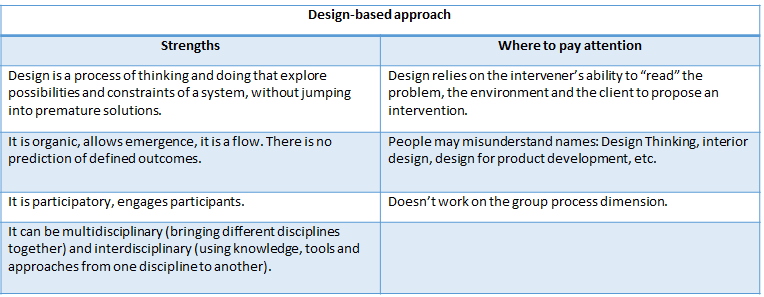
Key points related to Design Thinking
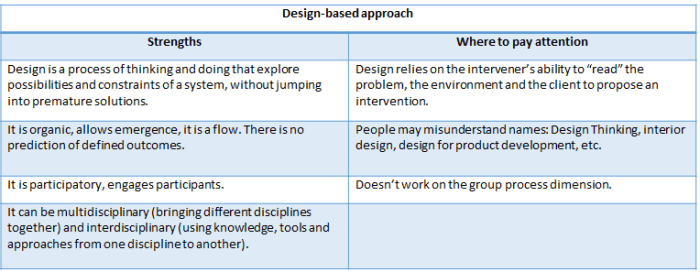
image post about DESIGN1

Design Thinking and I

As an Organizational Designer, when working in organizational change or facilitating team processes, I use inquiry and relationship building with the main client to seek for understandings about what the organization needs. Using dialogue and requesting partnership with the main client, we build together what the client needs, including elucidating some processes that sometimes even the client is not aware of.

Examples of how I have applied Design Thinking to organizational challenges at work are described in the following chart:

my cycle


OD – Design Thinking – Method in Complexity

The richest result, the richest process and the most delightful work experience will come from openness to learn how to blend different knowledge and perspectives. This is why I appreciate Design Thinking.


[1] MORIN, E. Ciência com Consciência. Rio de Janeiro/RJ: Bertrand Brasil, 2005.

[2] MACHADO, A. Antología poética. Madrid: Alianza, 1995.
INTERDISCIPLINARY HUMAN RESOURCES (IHR)

The Context of IHR

Since 1995 when I started my career in Human Resources (HR) I was exposed to Total Quality Management, strategic planning and other management theories like ISO 9000 and FSC (Forest Stewardship Council). Looking back, I learned and still learn many lessons. First, I learned how much HR was integrated to other practices inside business. Second, how HR could serve as a catalyzer to implement good practices. While doing that, HR was very close to its clients. Last, I learned how to work with multidisciplinary committees to pursue business’ goals. This position increased my interest around disciplines that are related to people at workplaces, reason why I studied group dynamics in 2002/03 and obtained my Master in Social Psychology using Complex Thought and Systems Thinking to research group process in team management in 2008/09. Now, as a graduate student at OSR – Organization Systems Renewal – I am rethinking all these areas of knowledge in the North American culture.

In my HR experience, I incorporated the OD approach and also concepts from other disciplines like Systems Thinking and Complex Thought. Currently, I am an active member of SRHM through the LWHRA (http://www.lwhra.org), and WA HR State Council (http://wastatecouncil.shrm.org), PNODN (http://www.pnodn.org), and ISSS (http://www.pnodn.org) so I navigate around different areas of knowledge bringing my HR identity to all of them and using their knowledge and tools to think a better HR practice. Since 2013 I started studying Liberating Structures (http://www.liberatingstructures.com) as a way to increase everyone’s participation in meetings, trainings, etc.

I believe HR practices can be enriched using different approaches to understand its own challenges and also how to support business’ needs.

When I hear about HRBP (HR as a Business Partner), which means that HR needs to understand business to better serve it, I like to add that a business partner process requires a mutual process, where HR work can, by its nature, enable the consideration of different perspectives, clarifying different levels of the system, so that we have a real partnership.

Liberating Structures

I just finished a two-day workshop about Liberating Structures (LS).

How did LS get on my path? I need to thank Michelle Miller that announced a LS user meeting in a PNODN meeting we both attended in 2013. I truly believe that good connections make us stronger. Being in good places bring good connections. We need to be opened to hear what is happening around us. And, we need to get out of our couch… then, a virtuous circle of good people and good activities surround us.

LS provokes many feelings and thoughts on me. It is a mix of freedom, authentic connection to our nature as human beings, genuine focus on what matters. It is an intercultural approach and at the same time brings a home-sweet-home feeling. I admire and trust people that are running LS. They are not looking for selling anything, they are genuinely sharing their knowledge. They don’t intent to build certifications or any programs that are only status-related.

LS is about participation, individual and group dynamics, brain and body movement. Walls fall down. Unspoken and invisible practices are revisited and are better developed, all voices are heard.

During the workshop, a participant said to me: “this is my first LS event. I am surprised by how informal it is” and that stroke me an important truth, despite me not paying attention to that. Speakers were participants most of the time and in assigned moments they were at the stage sharing their knowledge and facilitating our learning. People had a broad range of experience in terms of years, but no different status. What a dream to our workplaces and society: respect to the other, admiration, without having to consider different statuses.

Please accept my invitation to check more information about LS: http://www.liberatingstructures.com/

I wish you will share my enthusiasm.